
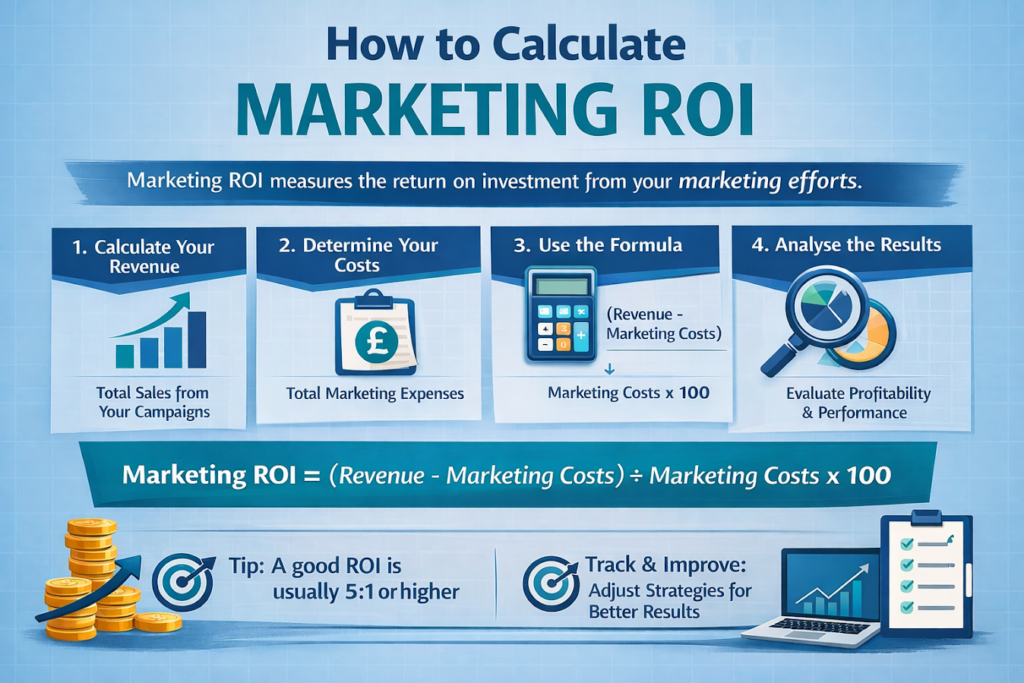
How to Calculate Marketing ROI (and Use It to Drive Real Growth)
Marketing is full of activity. Campaigns are launched, content is published, ads are optimised, and reports are shared. But underneath all of that, there is one question that matters more than anything else:
Is it actually making money?
That is where ROI (Return on Investment) becomes critical. It cuts through vanity metrics and gives you a clear answer on whether your marketing is working, where you should invest more, and what needs to change.
This guide will walk you through how to calculate marketing ROI properly, how to apply it across multiple channels, and how to build a system that your team can realistically use. You’ll also be able to download a ready-built calculator to put everything into practice immediately.
What Marketing ROI Really Means
At its core, ROI measures how much value you generate compared to what you spend. It is expressed as a percentage and shows whether your marketing is profitable.
The formula itself is simple:
ROI = (Revenue – Cost) ÷ Cost × 100
If you spend £1,000 and generate £3,000 in revenue, your ROI is 200%. That means you’ve made £2 profit for every £1 spent.
While the formula is straightforward, the challenge lies in applying it properly across real-world marketing activity.
Why ROI Is Often Misunderstood
Many teams believe they are tracking performance, but they are often measuring the wrong things. It’s easy to focus on clicks, impressions, or engagement because those numbers are readily available and tend to move quickly. However, they don’t tell you whether your marketing is delivering actual business value.
Another common issue is treating channels in isolation. Marketing rarely works in a straight line. A customer might see a social media post, click a paid advert later, and finally convert through email. If you don’t have a structured way of tracking performance across channels, your ROI figures become fragmented and unreliable.
There is also the problem of inconsistency. Without a standardised system, different campaigns are measured in different ways, making it difficult to compare performance or make confident decisions.
The Data You Actually Need
To calculate ROI effectively, you need a consistent set of inputs across every channel. These are not complicated, but they must be tracked properly.
You need to know how much you are spending, how many leads you generate, how many of those leads convert into customers, and how much revenue those conversions produce. Once these four elements are in place, you can begin to understand performance in a meaningful way.
From there, additional metrics such as cost per lead and cost per acquisition provide deeper insight into efficiency. These are not separate from ROI; they help explain why ROI looks the way it does.
Looking Beyond the Surface
When you start analysing ROI, you quickly realise that not all activity is equal. Two channels might generate the same number of leads, but one converts far better than the other. Another might produce fewer leads but significantly higher revenue.
This is where the real value of ROI comes in. It allows you to move beyond surface-level metrics and understand the quality of your marketing, not just the quantity.
For example, a channel with a high cost per lead might still be valuable if those leads convert at a high rate and generate strong revenue. On the other hand, a low-cost channel that produces large volumes of poor-quality leads can drain time and resources without delivering real returns.
The Complexity of Multi-Channel Marketing
Most organisations are not relying on a single marketing channel. Instead, they are operating across a mix of paid advertising, social media, email, partnerships, and organic search.
Each of these channels behaves differently. Paid channels tend to deliver faster results but come with direct costs. Organic channels often take longer to build but can provide sustainable, lower-cost acquisition over time.
The challenge is not just tracking each channel individually but understanding how they contribute to overall performance. Without a clear structure, it becomes difficult to identify which channels are driving growth and which are simply adding noise.
Why Social Media Needs Special Attention
Social media is one of the most misunderstood areas when it comes to ROI. Many teams treat it as a single channel, but in reality, it consists of two very different types of activity.
Paid social involves direct spend and is typically easier to measure. Organic social, on the other hand, relies on content, engagement, and long-term brand building. It does not always produce immediate conversions, but it can significantly influence customer behaviour over time.
If you combine these into one figure, you lose clarity. Separating paid and organic social allows you to see where your investment is going and how each approach contributes to your overall results.
Breaking social down further by platform adds another layer of insight. Performance on Facebook may look very different from LinkedIn or TikTok, and understanding those differences is key to making informed decisions.
Building a System That Works
To manage ROI effectively, you need more than just a formula. You need a structured system that captures data consistently and presents it in a way that is easy to interpret.
Each channel should be tracked using the same core inputs so that performance can be compared fairly. Social media should be broken down into its components, with platform-level data feeding into a broader view. All of this information should then roll up into a single, clear summary that shows total spend, total revenue, and overall ROI.
A dashboard is essential here. Without one, teams are forced to dig through spreadsheets to find answers, which slows down decision-making and increases the risk of error. A well-designed dashboard provides immediate visibility of what is working and what is not.
Making ROI Practical
Understanding ROI is one thing, but applying it consistently is where most teams struggle. This is often due to the tools they are using. Basic spreadsheets can quickly become difficult to manage, especially as the number of channels and campaigns grows.
To address this, we’ve created a ready-to-use Excel calculator that structures everything for you. It allows you to input your data and instantly see your performance across multiple channels.
The calculator includes a dedicated section for social media, separating paid and organic activity and allowing you to analyse performance at a platform level. It also automatically rolls this data into your main ROI view, so you can see the full picture without manual calculations.
A built-in dashboard provides a clear summary of your results, highlighting total spend, total revenue, and your best-performing channels.
Using ROI to Make Better Decisions
Once you have a reliable system in place, ROI becomes a powerful decision-making tool. It allows you to identify which channels deserve more investment and which need improvement.
If a channel is delivering strong returns at a low cost, it makes sense to scale it. Increasing budget in areas that are already performing well is one of the most effective ways to drive growth.
If another channel is generating leads but failing to convert, the issue may not be the channel itself but the journey that follows. In this case, improving landing pages, messaging, or follow-up processes can have a significant impact.
There will also be situations where a channel consistently underperforms despite optimisation efforts. In these cases, ROI provides the evidence needed to reallocate budget with confidence.
Thinking Long Term
While ROI is often used to assess short-term performance, it is equally important to consider the long-term impact of your marketing.
Some channels, particularly organic ones, may not deliver immediate returns but contribute to brand awareness and customer trust. These factors can influence conversions later in the journey, even if they are not directly attributed.
Incorporating metrics such as customer lifetime value can provide a more complete picture. Instead of focusing solely on the revenue from a single transaction, you begin to understand the total value a customer brings over time. This can significantly change how you evaluate ROI and where you choose to invest.
Avoiding Common Pitfalls
One of the most common mistakes is relying too heavily on short-term data. Marketing performance can fluctuate, and making decisions based on a small sample can lead to poor outcomes.
Another issue is failing to update data regularly. ROI is only useful if it reflects current performance. Outdated figures can give a false sense of confidence or highlight problems that no longer exist.
There is also a tendency to focus on individual channels without considering the bigger picture. While channel-level analysis is important, it should always be viewed within the context of overall performance.
Bringing It All Together
Marketing ROI is not just a calculation; it is a framework for understanding and improving performance. When used properly, it provides clarity, direction, and confidence in decision-making.
By tracking the right data, structuring it effectively, and reviewing it consistently, you can move beyond guesswork and start making strategic choices that drive real results.
The key is not to overcomplicate it. Start with the fundamentals, build a system that works for your team, and refine it over time.
If you want to put this into action straight away, download the calculator and start tracking your ROI properly: